
High Holy Day

Overview:
Sukkot:
Nothing but Joy!
After the High Holy Day of Atonement (Yom Kippur), we celebrate The High Holy Day of Sukkot, which is also known as The Feast of Booths.
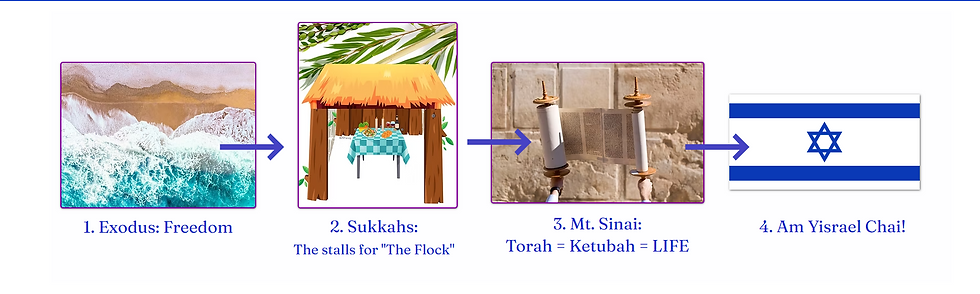
During this High Holy Day, we celebrate and commemorate how Hashem brought our Jewish ancestors out of Egypt and into the wilderness. Free from Egypt, Hashem brought His beloved Hebrew people to the wilderness so that we could worship Him, receive the Torah, and thereby become His Holy Nation of priests.
The journey in the wilderness included a stop in the town of Succoth.
Then Hashem met with Moshe on Mount Sinai, where Hashem provided the Torah by which His new nation Israel would live. Within this covenant of the Torah, Hashem gave the instructions for the building of His booth-like dwelling place among the Jewish people: His Tabernacle.
This Tabernacle of Hashem was set in the middle of the Israelite camp, where our ancestors also dwelt in sukkahs (i.e. booths, or tents). These temporary dwellings were like the animal stalls our Avinu Jacob built in the town of Sukkoth. Thus, the true "baby in the manger" (if you will), was the newly-born Jewish nation of Israel.
If we take the account of Genesis 33:17 into consideration, this seeingly mundane fact becomes very significant. From Genesis 33:17, we can understand that by having our Jewish ancestors live in sukkahs, Hashem is telling us through our Jewish ancestors that He was building a house for Himself among His beloved, chosen first born son--The 12 Tribes of Israel (Exodus 4:22).
Thus, like Avinu Jacob, by commanding the building of the Tabernacle, Hashem was establishing His home amongst His Jewish people, and therefore, the tents of our forefathers became like the stalls for Hashem's flock.
Though Hashem's dwelling place (the Holy Temple) does not now stand, Ezekiel 40-48 promises that there will be a third temple, which will stand eternally. To this Temple, Hashem will gather all of His Jewish people, and will again make His home among His flock. At that time every eye on earth will see, know, and worship Hashem alone as G-d. Thus, every nation will come up every year to celebrate Sukkot! (See Zechariah 14:16-19).
Thus, during this Holy Day of Sukkot, we celebrate by constructing temporary booth-like structures to eat and dwell in as a reminder of Hashem's eternal promise to dwell with and among us, His Jewish people eternally. We also celebrate with joy, song and dance, for which Hashem promises to bless by blessing the crops and all of the undertakings of our hands.
Why?
Hashem declares that the Jewish Israelites are the firstfruit of His harvest (Jeremiah 2:3). The Exodus, Mount Sinai, and even the wilderness wandering all paved the way for His firstfruit Jewish Nation of Israel to grow and come into fruition. Thus, this Holy Day celebrates all of the mercies, miracles, and powerful promises of Hashem, our G-d.
When is
Sukkot?
25 September 2026 -
2 October 2026
Shmini Atzeret:
2 October 2026 -
3 October 2026
3 Holy Days in 1
01.
Sukkot
At the end of Sukkot, there are 2 distinct Holy Days
that are connected to, but distinct from Sukkot.
02.
Hoshanah Rabbah
When: October 2, 2026 (in Israel),
October 3, 2026 (outside of Israel)
Celebration on the 7th day of Sukkot, which celebrates the last day of the "Days of Judgement", which began on Rosh Hashanah.
03.
Shemini Atzret
When:
October 2-3, 2026 (outside of Israel)
Celebration of great joy on the 8th day of Sukkot, as commanded in Leviticus 23:36.
Holy Day Torah Portions
Tanakh
This page displays the Diaspora holiday schedule. The Israel schedule is used by Jews living in modern Israel.
Sukkot I (on Shabbat) / סוּכּוֹת יוֹם א׳ (בְּשַׁבָּת)
Saturday, 26 September 2026 / 15 Tishrei 5787
Torah Portion: Leviticus 22:26-23:44; Numbers 29:12-16
1: Leviticus 22:26-33 · 8 p’sukim
2: Leviticus 23:1-3 · 3 p’sukim
3: Leviticus 23:4-8 · 5 p’sukim
4: Leviticus 23:9-14 · 6 p’sukim
5: Leviticus 23:15-22 · 8 p’sukim
6: Leviticus 23:23-32 · 10 p’sukim
7: Leviticus 23:33-44 · 12 p’sukim
maf: Numbers 29:12-16 · 5 p’sukim
Haftarah: Zechariah 14:1-21 · 21 p’sukim
Sukkot II / סוּכּוֹת ב׳
Sunday, 27 September 2026 / 16 Tishrei 5787
Torah Portion: Leviticus 22:26-23:44; Numbers 29:12-16
1: Leviticus 22:26-23:3 · 11 p’sukim
2: Leviticus 23:4-14 · 11 p’sukim
3: Leviticus 23:15-22 · 8 p’sukim
4: Leviticus 23:23-32 · 10 p’sukim
5: Leviticus 23:33-44 · 12 p’sukim
maf: Numbers 29:12-16 · 5 p’sukim
Haftarah: I Kings 8:2-21 · 20 p’sukim
Sukkot Chol ha-Moed Day 1 / סוּכּוֹת חוֹל הַמּוֹעֵד יוֹם א׳
Monday, 28 September 2026 / 17 Tishrei 5787
Torah Portion: Numbers 29:17-25, 29:17-22
1: Numbers 29:17-19 · 3 p’sukim
2: Numbers 29:20-22 · 3 p’sukim
3: Numbers 29:23-25 · 3 p’sukim
4: Numbers 29:17-22 · 6 p’sukim
Sukkot Chol ha-Moed Day 2 / סוּכּוֹת חוֹל הַמּוֹעֵד יוֹם ב׳
Tuesday, 29 September 2026 / 18 Tishrei 5787
Torah Portion: Numbers 29:20-28, 29:20-25
1: Numbers 29:20-22 · 3 p’sukim
2: Numbers 29:23-25 · 3 p’sukim
3: Numbers 29:26-28 · 3 p’sukim
4: Numbers 29:20-25 · 6 p’sukim
Sukkot Chol ha-Moed Day 3 / סוּכּוֹת חוֹל הַמּוֹעֵד יוֹם ג׳
Wednesday, 30 September 2026 / 19 Tishrei 5787
Torah Portion: Numbers 29:23-31, 29:23-28
1: Numbers 29:23-25 · 3 p’sukim
2: Numbers 29:26-28 · 3 p’sukim
3: Numbers 29:29-31 · 3 p’sukim
4: Numbers 29:23-28 · 6 p’sukim
Sukkot Chol ha-Moed Day 4 / סוּכּוֹת חוֹל הַמּוֹעֵד יוֹם ד׳
Thursday, 1 October 2026 / 20 Tishrei 5787
Torah Portion: Numbers 29:26-34, 29:26-31
1: Numbers 29:26-28 · 3 p’sukim
2: Numbers 29:29-31 · 3 p’sukim
3: Numbers 29:32-34 · 3 p’sukim
4: Numbers 29:26-31 · 6 p’sukim
Sukkot Final Day (Hoshana Raba) / סוּכּוֹת ז׳ (הוֹשַׁעְנָא רַבָּה)
Friday, 2 October 2026 / 21 Tishrei 5787
Torah Portion: Numbers 29:26-34
1: Numbers 29:26-28 · 3 p’sukim
2: Numbers 29:29-31 · 3 p’sukim
3: Numbers 29:32-34 · 3 p’sukim
4: Numbers 29:29-34 · 6 p’sukim
References
“Sukkot” in Wikipedia: The Free Encyclopedia
Wikimedia Foundation Inc.