
High Holy Day
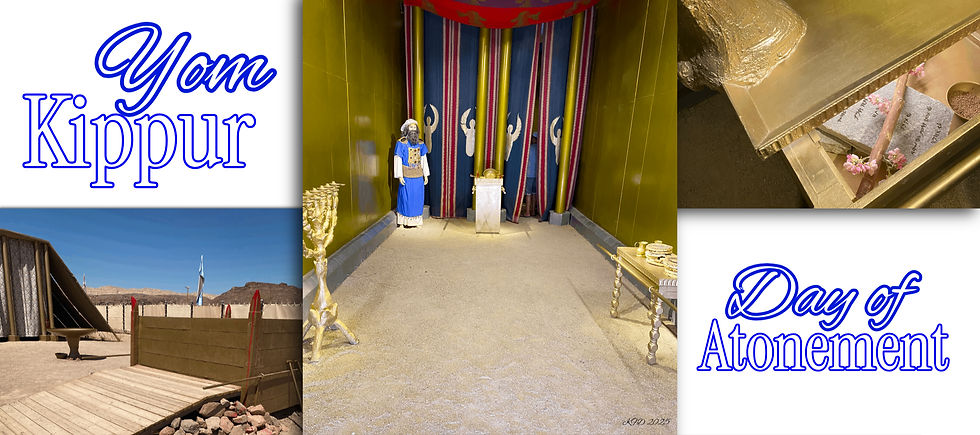
Overview:
Yom Kippur: The High Holy Day of Atonement
This High Holy Day marks the Holiest Day of the Jewish Year.
What makes Yom Kippur so miraculous is that this High Holy Day is a day that Hashem has sactified as the day of yearly Atonement for all Jewish people.
When the Temple stood (and when it will again stand--may it be today!), the Temple rites of the Priests & High Priest on Yom Kippur assure the yearly atonement of every sin for every Jewish person in Hashem's Heavenly family (Leviticus 16).
The Chai-lights of the Yom Kippur ceremony listed below have been given to the Jewish people by Hashem as "a law for all time to make atonement for the Israelites for all their sins once a year" (Leviticus 16:34). Thus, though the temple does not now stand, it will again, and eternally the High Holy Day of Yom Kippur will be reinstated to its proper order.
It must be said, that though The Holy Temple is needed to fully celebrate this High Holy Day of Atonement, we trust and believe that Hashem will accept the "offering of our lips" (Hosea 14) while moshiach terries and His Temple lays in ruins. For, "the offering of our lips" includes teshuvah, which is the action that is promised to bring redemption (and the Redeemer, Hashem) to the house of Jacob--meaning to the Jewish People!
When is Yom Kippur?
20 September 2026
-
21 September 2026
3 Animal Sacrifices
01.
1 Bull:
for the communal offering for the Sins of the High Priest & Priests
(Leviticus 16:6)
02.
1 Ram:
to be a burnt offering for the entire Jewish Congregation.
(Leviticus 16:3)
03.
2 Male Goats:
-
One offered as a sacrificial sin offering: which is usually the sin offering for the chieftains.
-
One for Azazel: kept alive and sent away with the sins of the people placed on it.
(Leviticus 16:7-10)
3 Locations of Blood Placement
NOTE: Yom Kippur is the one day every year when the High Priest is allowed to go behind the veil and enter the Holy of Holies. This entrance into the Holy of Holies is for the specific purpose of cleansing Hashem's sanctuary of the "uncleanliness and transgressions" of the Jewish congregation, removing the defilement from the presence of Hashem (Leviticus 16:16).
As we have learned in our studies in Parsha Tzav (Leviticus 6:1-8:36), it is the blood of the animal sacrifices that cleanses the altars (both the burnt offering altar and the aromatic altar) and the cover of the Ark of the Pact on Yom Kippur. The cleansing provided by the blood prepares the altars so that the fat of the animal sacrifices can be burned and turned into smoke, which provides expiation and forgiveness of all sins.
01.
The blood of the Bull is to be mixed with glowing coals from the incense altar and aromatic incense. The mixture is to be sprinkled 7 times on the place of Hashem's dwelling in the Tent of Meeting, which is located on top of the Ark of The Covenant, behind the veil.
(Leviticus 16:11-14)
02.
The blood of the sacrificed goat is sprinkled on the place of Hashem's dwelling on top of the Ark after the blood of the bull.
(Leviticus 16:15)
03.
The blood of the bull and the goat are then to be placed on the 4 horns of the incense alter inside the tent of meeting.
-
Then the blood is to be sprinkled 7 times on the incense altar.
-
These actions both cleanse and consecrate the incense altar.
(Leviticus 16:17-19)
3 Actions Performed For
Expiation & Forgiveness
01.
The priest places his hands on the head of the live goat and recites the iniquities and transgressions of the Jewish people, thereby transferring the sins away from the people and on to the goat.
Then
A "designated man" ('itti) sends the live goat into the wilderness so that the sins of the Jewish Israelites will be removed to an "inaccessible place."
When he finished his duties, the designated man washed, changed his clothes, then reentered the congregation.
(Leviticus 16:20-22; 26)
02.
The High Priest is to change his clothing inside the tent of meeting and leave his soiled garments inside the tent. Then he is to bath in water and put on fresh garments.
He is to come out of the tent only when cleaned and changed and then offer:
1. His Burnt offering
and then
2. The burnt offering of the people
(the Ram)
(Leviticus 16:23-24)
03.
The priest will take the bull and the goat (whose blood was used for purging the sanctuary) to a clean place outside of the Jewish people's place of dwelling. Then he is to turn the fat, flesh, hides, and innards of the bull and sacrificed goat to smoke.
This fat turned to smoke provides the expiation of sin and leads to full forgiveness of sins.
(Leviticus 16:27-28)
Holy Day Torah Portions
Tanakh
Yom Kippur / יוֹם כִּפּוּר
Monday, 21 September 2026 / 10 Tishrei 5787
Torah Portion: Leviticus 16:1-34; Numbers 29:7-11
1: Leviticus 16:1-6 · 6 p’sukim
2: Leviticus 16:7-11 · 5 p’sukim
3: Leviticus 16:12-17 · 6 p’sukim
4: Leviticus 16:18-24 · 7 p’sukim
5: Leviticus 16:25-30 · 6 p’sukim
6: Leviticus 16:31-34 · 4 p’sukim
maf: Numbers 29:7-11 · 5 p’sukim
Haftarah: Isaiah 57:14-58:14 · 22 p’sukim
Yom Kippur (Mincha) / יוֹ
ם כִּפּוּר (מִנְחָה)Monday, 21 September 2026 / 10 Tishrei 5787
Torah Portion: Leviticus 18:1-30
1: Leviticus 18:1-5 · 5 p’sukim
2: Leviticus 18:6-21 · 16 p’sukim
maf: Leviticus 18:22-30 · 9 p’sukim
Haftarah: Jonah 1:1-4:11; Micah 7:18-20 · 51 p’sukim
References
“Yom Kippur” in Wikipedia: The Free Encyclopedia
Wikimedia Foundation Inc.